
Global sugar prices have surged by nearly 25% since the beginning of the year. The sharp increase reflects a tightening global sugar supply caused by El Niño weather disruptions, rising ethanol production, and sugar export restrictions in key producing countries.
Global sugar supply tightens as prices continue to climb
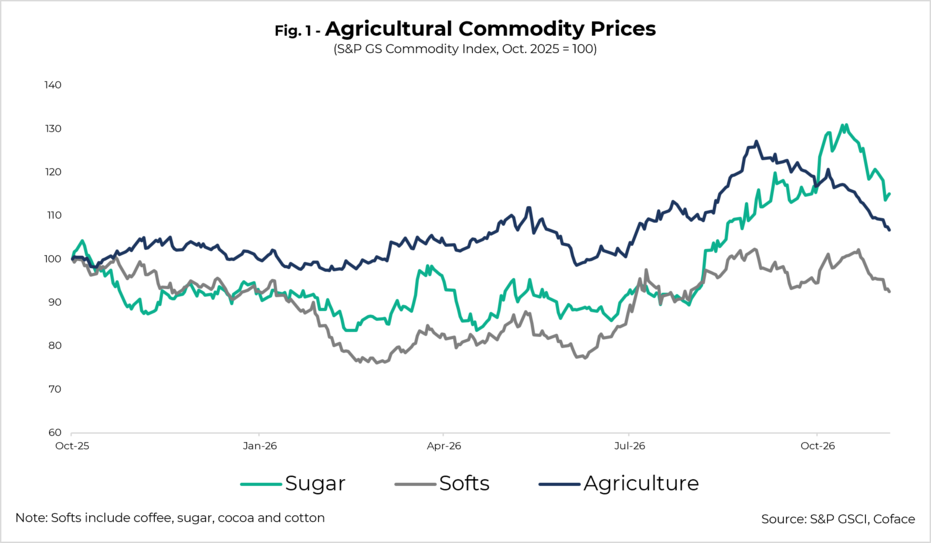
While most agricultural commodity markets have remained relatively stable since the start of the new marketing year, sugar prices have continued their upward trajectory. Although the S&P GSCI Agriculture Index has declined by 16% since early September, the sugar index has still gained 1% during the same period (Figure 1). Since the start of the year, the benchmark price for raw sugar has climbed by around 25%, surpassing US$450 per ton in mid-October, its highest level in nearly two years.
Data for graph in .xlsx format
With global sugar demand remaining stable, market dynamics are increasingly driven by supply-side pressures. Three key factors are supporting higher sugar prices:
- adverse weather conditions linked to El Niño,
- growing demand for biofuels due to higher oil prices,
- and sugar export restrictions in major producing countries.
The International Sugar Organization now projects a global sugar deficit of 0.2 million tons (Mt) for the 2026/2027 marketing year (October–September), following a surplus of 1.1 Mt in the previous season. This forecast reflects expected declines in sugar production across key producing regions that account for more than half of global output. However, several risk factors suggest the global sugar deficit could be larger than anticipated, potentially keeping sugar prices elevated in the months ahead.
El Niño impacts major sugar-producing countries
In Brazil, the world's largest sugar producer, accounting for 23.5% of global sugar production, heavy rainfall in September and early October across the Centre-South region, responsible for more than 90% of domestic output, has disrupted harvesting and sugarcane processing operations. Excessive rainfall has delayed access to plantations and increased water content in sugarcane, reducing sugar concentration. As a result, total cane crushing volumes from March through September fell by 2.9% year-on-year to 510 Mt.
In India, the world's second-largest sugar producer, representing 16% of global production, the south-west monsoon, which plays a critical role in sugarcane development between June and September, ended with a national rainfall deficit of 12.6%, negatively affecting crop growth and expected sugar yields.
A similar trend is visible in Thailand, the world's fifth-largest sugar producer and the second-largest sugar exporter after Brazil. Thai sugar production is expected to decline by 17% in 2026/2027, falling below 10 Mt. These developments are directly linked to the exceptional strength of the current El Niño weather event, which is expected to continue affecting global sugar production until at least the first quarter of 2027.
In the European Union, the world's third-largest sugar producer with an 8% share of global output, record-breaking summer heatwaves have significantly damaged sugar beet crops, independent of El Niño effects. As a result, EU sugar production is projected to fall by 20% in the 2026/27 marketing year to 13.5 Mt.
Rising ethanol production structurally reduces global sugar supply
To reduce dependence on imported gasoline and diesel, Brazil and India have steadily increased mandatory ethanol blending rates in recent years. In July, Brazil raised its ethanol blending requirement from 30% to 32% through January 2027, while India reached its 20% target, originally set in 2018 for 2030, ahead of schedule in 2025. Each increase in ethanol blending diverts more sugarcane away from sugar production and toward biofuel manufacturing.
Higher oil prices since the outbreak of the conflict in Iran, combined with weaker sugar prices earlier in the year, have further encouraged producers to allocate sugarcane to ethanol production.
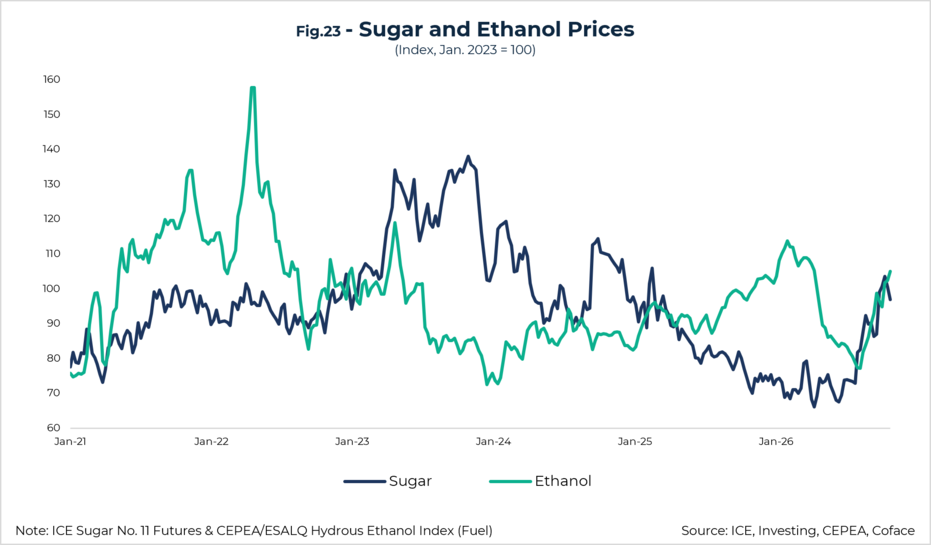
In Brazil's South-Central region, the share of sugarcane used for sugar production dropped below 47% during the first five months of the 2026/2027 season (April–March), compared with nearly 53% during the same period a year earlier. Although recent gains in sugar prices have improved the profitability of sugar manufacturing (Figure 2), these adjustments are unlikely to fully offset the production shortfall. By mid-October, sugar production was down 14.6% year-on-year, while ethanol production increased by 4.3%.
Data for graph in .xlsx format
India's sugar export restrictions intensify global market pressures
India, formerly the world's second-largest sugar exporter until 2023, has progressively reduced sugar exports before implementing an almost complete export ban in May 2026 to safeguard domestic supply. At the same time, the government introduced a tariff-rate quota allowing imports of 1 Mt of raw sugar until 31 October.
Authorities have gone even further by prohibiting the use of sugarcane for ethanol production from 1 November. This measure is expected to preserve domestic sugar availability at 28 Mt for consumption during the 2026/2027 marketing year, matching the previous season's level. Of the country's projected 31 Mt of sugar production, approximately 3 Mt had originally been allocated to ethanol production.
India's policy increases the global sugar market's reliance on Brazil, which already accounts for 55% of worldwide sugar exports, while also increasing market exposure to any production disruptions in the country.


