
While much of Europe’s industrial sector continues to face challenges from energy market volatility and geopolitical uncertainty, Spain is outperforming many of its peers. Spanish manufacturing production has already exceeded pre-war levels, supported by a diversified industrial base, competitive labour costs, and rapid growth in renewable energy capacity. Although these strengths position Spain as an attractive manufacturing hub, long-term success will depend on addressing structural issues such as productivity growth and electricity infrastructure investment.
Key figures
- 43 %: lower hourly manufacturing labour costs compared with Germany.
- 58 %: share of renewable energy in Spain’s electricity mix in 2024.
Whilst Europe’s industrial heartland remains weakened by successive shocks, Spanish industry is proving more dynamic. Its resilience is underpinned by a diversified production base, competitive costs and strong energy potential.
The real challenge now is to convert these advantages into sustainable productivity gains.
says Laurine PIVIDAL, Economist for Southern Europe at Coface.
An Industry Outperforming Its European Peers
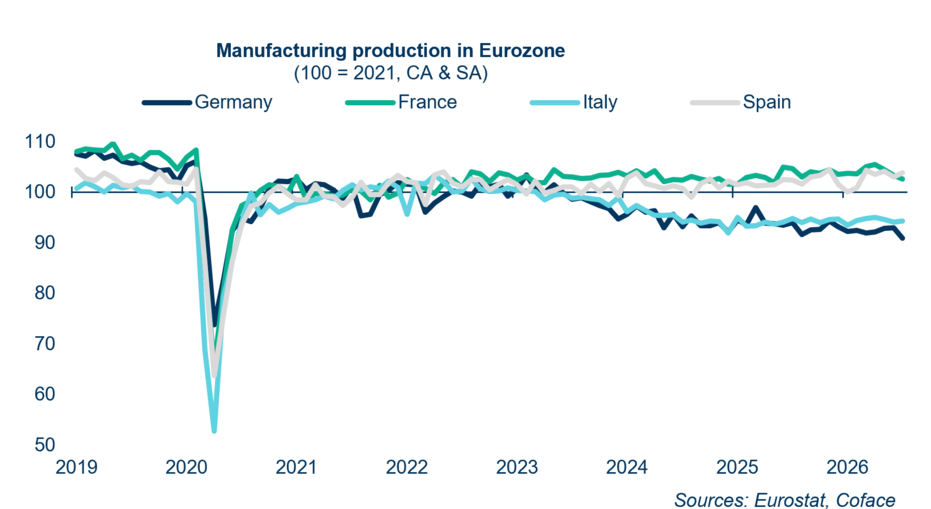
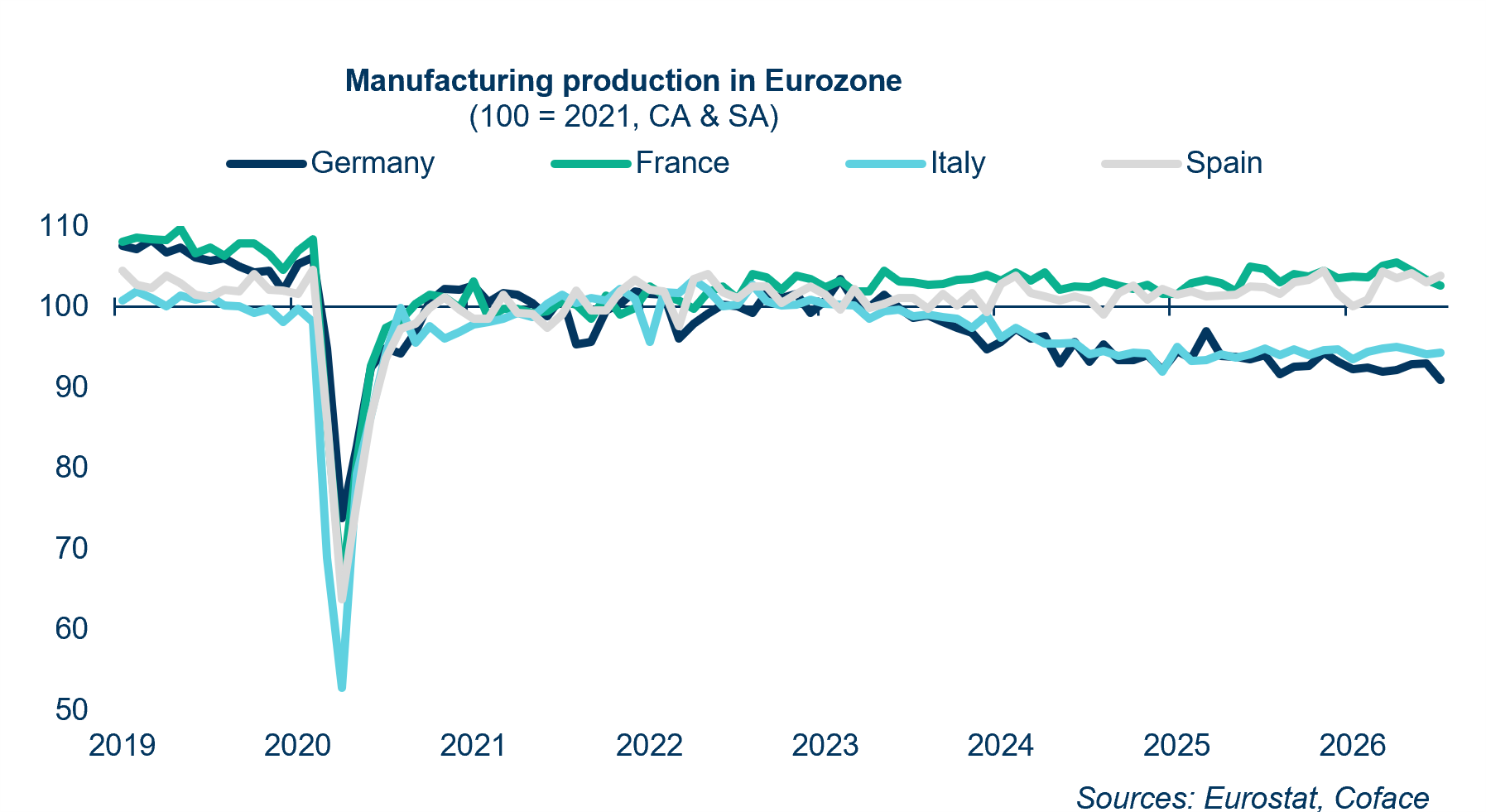
Since 2022, Spain has ranked among Europe’s fastest-growing economies, recording annual growth rates significantly above the European Union average. The manufacturing sector reflects this momentum, with industrial output already surpassing pre-Ukraine war levels, while major economies such as Germany and Italy continue to lag behind.
Spain’s strong performance is supported by a more balanced industrial structure. Unlike Germany and Italy, which remain heavily exposed to sectors impacted by the energy crisis, including automotive manufacturing, machinery, and metalworking, Spain benefits from greater diversification. High-value industries such as pharmaceuticals, electrical equipment, and electronics are expanding rapidly, alongside key energy-intensive sectors including chemicals, plastics, and paper production.
This competitiveness also extends beyond Spain’s domestic market. The country has successfully maintained its export market share within the European Union since 2015, contrasting with the declining export shares observed in Germany and France.
Data used for the graph in .xlsx format
A Competitive Labour Cost Advantage Facing New Pressures
One of Spain’s most significant manufacturing advantages remains its relatively low labour costs. In 2025, hourly labour costs in the manufacturing sector are projected to remain substantially below those of other major European economies, standing 40% lower than France and 43% lower than Germany. This cost advantage helps Spanish manufacturers remain competitive and offsets lower productivity levels.
However, this advantage may become more difficult to sustain in the years ahead. Between 2022 and 2025, hourly labour costs in manufacturing increased by 15%, while real productivity growth remained below 3%. Meanwhile, employment growth has been concentrated in lower value-added activities. If wage growth continues to outpace productivity improvements, Spain’s manufacturing competitiveness could gradually come under pressure.
Renewable Energy: Spain’s Untapped Competitive Edge
The rapid expansion of solar and wind energy has transformed Spain’s power sector in recent years. As a result, the country is considerably less dependent on natural gas than many European neighbours, with gas influencing electricity prices only 15% of the time, compared with 89% in Italy at the beginning of 2026. This reduced exposure to fossil fuel price fluctuations has strengthened Spain’s energy resilience and helped position the country as Europe’s leading market for Power Purchase Agreements (PPAs), representing approximately one-quarter of contracted capacity.
Data used for the graph in .xlsx format
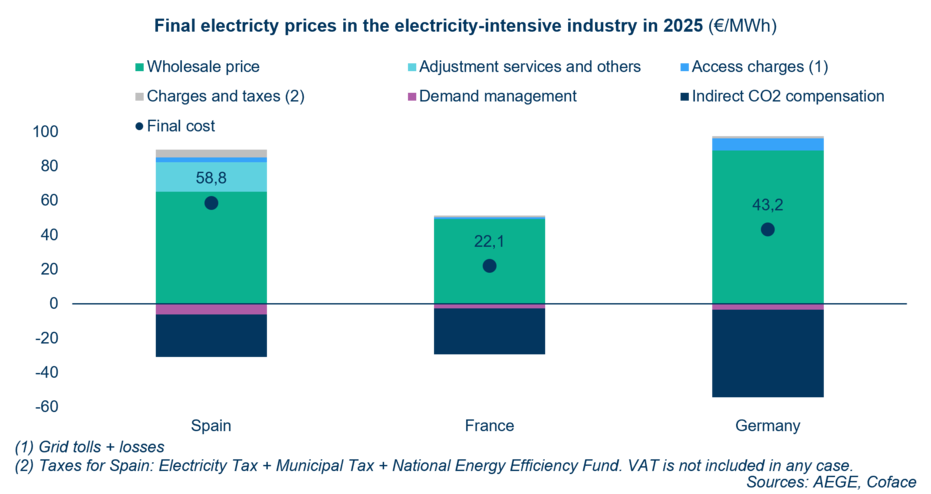
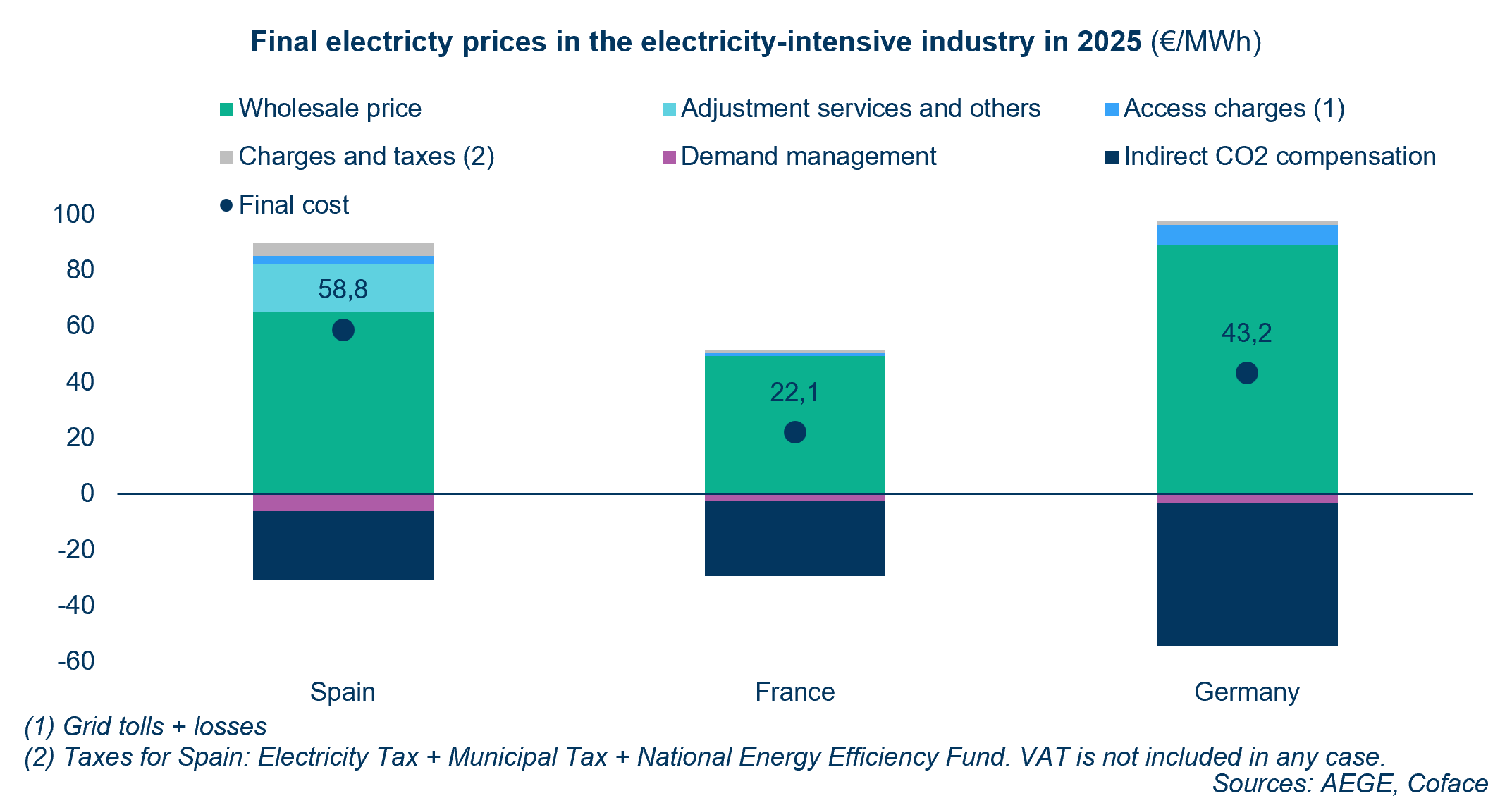
Despite these advantages, lower wholesale electricity prices have not yet been fully reflected in industrial energy costs. Limited subsidies, rising grid charges, and underinvestment in electricity transmission and storage infrastructure continue to restrict the benefits for manufacturers. Spain invests only $0.30 in electricity grid infrastructure for every dollar invested in renewable energy, compared with approximately $0.70 across most European countries. As a result, up to 11% of renewable electricity generation was curtailed in 2025 due to grid capacity constraints.
Nevertheless, the outlook remains promising. The planned phase-out of German support schemes for energy-intensive industries by 2030, combined with Spain’s commitment to invest an additional €17.9 billion in electricity grid infrastructure, could further strengthen the country’s industrial competitiveness. As manufacturing sectors continue to decarbonise, reliable access to affordable renewable energy may become one of Spain’s most important strategic advantages.
Download our full analysis of Spain’s manufacturing sector and industrial competitiveness.


