
Coface has published the 10th edition of its Corporate Payment Survey in Germany, conducted among 503 companies. Although economic growth is gradually returning and German businesses are becoming more optimistic about 2027, this improvement has not yet translated into better payment behavior. 82% of companies experienced payment delays over the past twelve months, the highest level since 2019. At the same time, businesses are shortening payment terms to protect cash flow, while long overdue payments and rising insolvencies continue to signal elevated credit risk.
Key figures
- 82% of German companies reported payment delays in 2026.
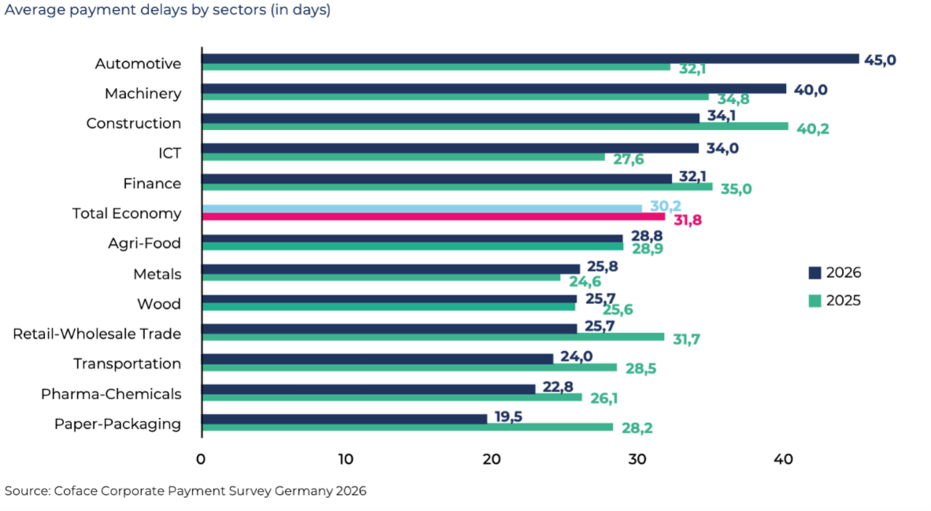
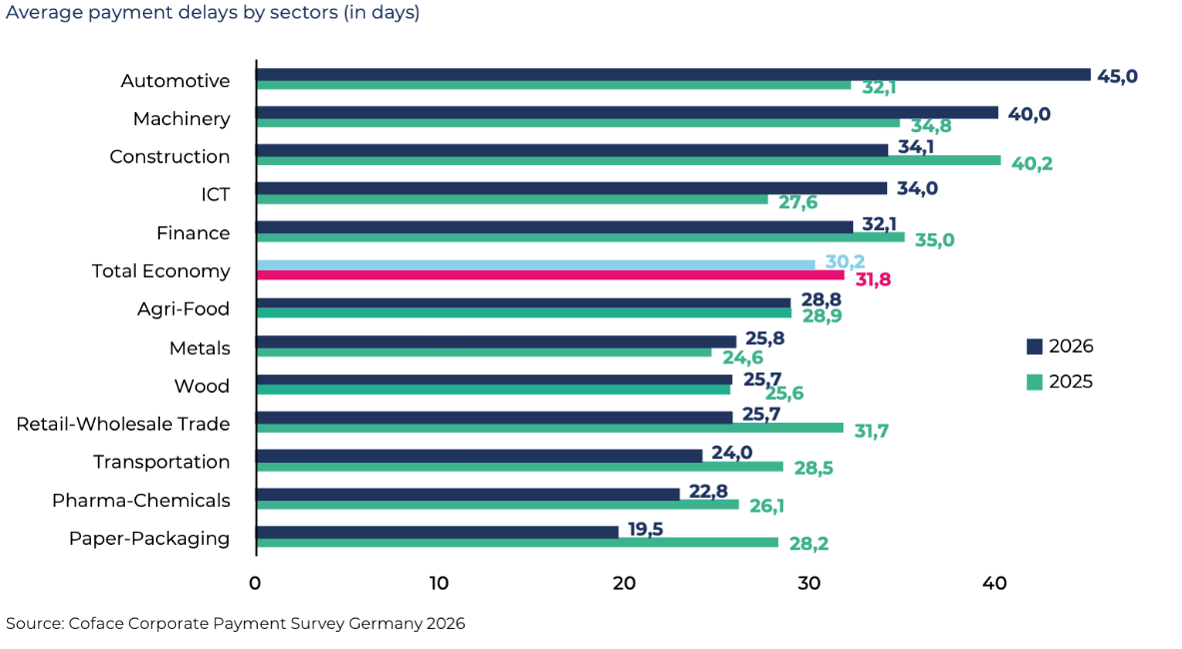
- Average payment delays declined slightly to 30.2 days, down from 31.8 days in 2025, while payment terms shortened to 30.6 days, their lowest level in nearly a decade.
- Corporate insolvencies are expected to climb by another 5% in 2026, with elevated credit risk likely to persist through 2027.
Payment Delays Reach Their Highest Level Since 2019
Payment delays have become a structural challenge for German businesses. More than four out of five companies experienced late payments over the past twelve months, marking the highest incidence recorded in seven years. Although outstanding invoices are being settled slightly faster on average than in previous years, delays remain significantly above healthy levels. The automotive industry faces the greatest strain, with average payment delays reaching 45 days, while the paper and packaging sector continues to demonstrate the strongest payment discipline, averaging just 19.5 days.
Data used for the graph in .xlsx format
Customer financial distress remains the primary driver of payment delays. Increasingly, companies are suffering from a chain reaction effect, with 33% reporting that payment issues originate from delays affecting their customers’ own clients. This highlights how financial pressure is spreading throughout the wider economy.
Overdue Receivables and Insolvencies Continue to Raise Red Flags
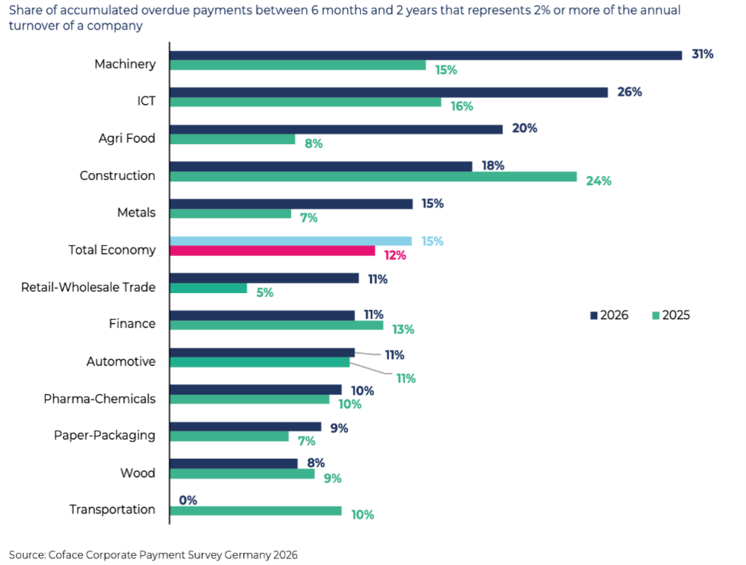
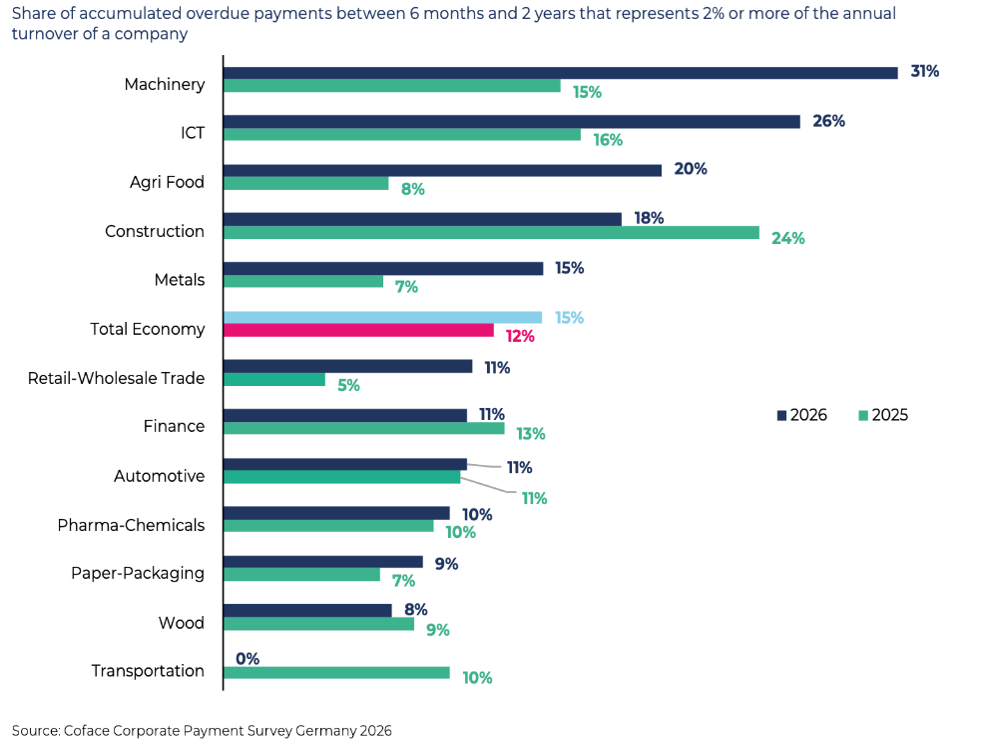
Beyond the rising frequency of late payments, the growing volume of long-overdue invoices is a major concern. Fifteen percent of companies report that receivables overdue between six and 24 months account for at least 2% of annual turnover. Smaller businesses are particularly vulnerable, as prolonged payment cycles place additional pressure on cash flow and financial stability.
Data used for the graph in .xlsx format
At the same time, corporate insolvencies continue to increase. Germany has experienced a steady rise in business failures since 2022, and Coface expects this trend to continue with a further 5% increase in 2026. Insolvency levels are expected to remain historically high throughout 2027.
2027: Confidence Returns, but Vulnerabilities Remain
Despite ongoing payment challenges, German companies are entering 2027 with greater optimism. While many businesses reported weaker trading conditions during 2026, expectations for the coming year have improved considerably. One in four companies expects business conditions to strengthen, while only 15% anticipate further deterioration. Nearly half expect a stable operating environment.
This confidence is driven primarily by opportunities within the domestic market. Germany remains the preferred growth destination for 74% of respondents, reinforcing confidence in the country’s long-term economic potential. Markets within the EU and EFTA also remain attractive, whereas interest in the United States and China has weakened significantly. Just 4% of respondents view the US as their main growth opportunity and only 1% cite China, reflecting concerns around US trade barriers and fierce competition in the Chinese market.
Business leaders also identify predominantly domestic threats to growth. High operating costs, regulatory complexity and administrative burdens are considered the biggest barriers to success, followed by weak domestic demand and political uncertainty.
While stronger GDP growth could help improve payment performance in the years ahead, Germany’s recovery remains heavily dependent on fiscal support measures. As a result, the risk of delayed payments and debtor default is expected to remain elevated throughout 2027.
> Discover the full findings of Germany’s Corporate Payment Survey by downloading the complete report.


