
Coface, a leading expert in trade credit insurance, debt collection and information services, has published the second edition of its survey (1) on UK companies’ payment behaviour, revealing that businesses are increasingly focused on preserving cash flow and are struggling to make ends meet. As companies extend payment terms to carefully manage cash flow pressures, many are caught in a stagnant cycle of supply chain disruption, leaving profitability finely balanced and investment confidence weakened.
Key figures
- Financial difficulties are the leading cause of late payments, with nine in ten UK companies experiencing payment delays during the past year. Payments are overdue by an average of 34 days, two days longer than last year, highlighting the deteriorating financial position of companies.
- Agreed payment terms have lengthened to an average of 57 days, nearly a week longer than last year and now among the longest in Europe, as firms build longer timeframes into their payment processes.
- The majority of AI users report increased outsourcing, suggesting that the technology is adding new supplier costs rather than replacing them.
- Nearly half (45%) of businesses expect the UK economy to deteriorate over the next 12 months, and 57% now expect late payments to rise, up from just 37% last year.
Payment delays worsen as business sentiment deteriorates
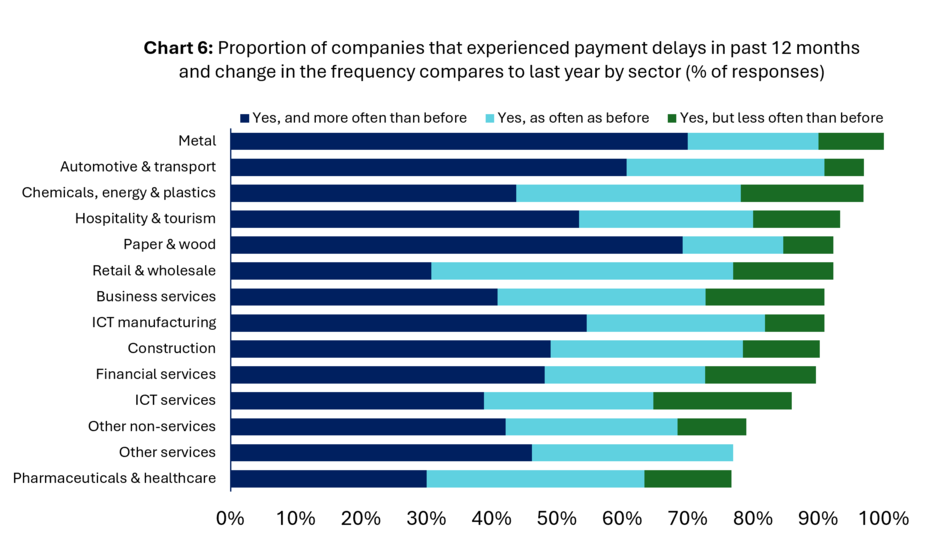
Late payments remain widespread, with 89% of UK companies reporting delays during the past year.
Payments are now an average of 34 days overdue, two days longer than a year ago, with customers citing financial difficulties (37%) as the leading cause, followed by organisational issues (26%).
No sector reported a net improvement in payment behaviour, and sharp deteriorations were observed in the paper & wood, metals, and automotive & transport sectors due to increased Chinese competition, higher US tariffs and supply chain disruption linked to the conflict involving Iran.
(Data for graphic in .xlsx format)
Looking ahead, more than half of respondents (57%) expect late payments to increase over the next 12 months as macroeconomic conditions become more challenging.
Payment terms continue to lengthen, increasing pressure on smaller businesses
Offering payment terms remains common practice in the UK, with only 1.6% of respondents not providing payment terms. However, average payment terms are now six days longer than in previous years, standing at 57 days and making them among the longest reported in Europe.
One-third of large companies offer payment terms exceeding 90 days, compared with just 12% of micro and small businesses. The longest payment terms are found in manufacturing and industrial sectors such as energy, plastics, chemicals and automotive, while domestically focused service sectors including hospitality, tourism, pharmaceuticals and healthcare generally maintain shorter terms due to tighter cash flow management.
Longer payment terms are increasing the pressure on SMEs. While large organisations can absorb delayed payments, many smaller businesses are already operating on a knife edge, carefully managing cash flow simply to stay afloat.
With economic conditions expected to worsen further, every additional day spent waiting to be paid limits their ability to grow and withstand future shocks,
says Benoit URBIN, Country Manager for the United Kingdom and Ireland
AI's hidden supply chain burden
Rather than reducing supplier spending, AI is adding another layer of costs for businesses. 80% of companies using AI said the technology has changed how they use external providers, with most reporting increased, rather than reduced, reliance on third-party expertise. Among large companies, customer support was the only function where more businesses reported bringing activities in-house than increasing outsourcing.
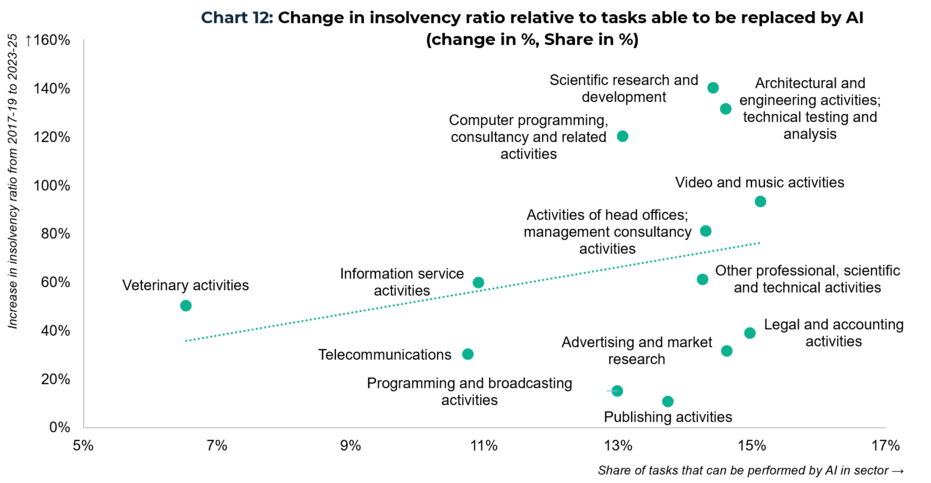
The survey findings also indicate a link between higher levels of AI exposure and rising insolvency rates across several sectors, suggesting that suppliers unable to adapt to technological change may face growing pressure despite the overall increase in AI-related demand.
(Data for graphic in .xlsx format)
Businesses expect profitability, but confidence rests on fragile foundations
While a greater share of respondents expect the UK economy to deteriorate during the next 12 months (45%) than improve (25%), businesses remain relatively optimistic about their own prospects, with 51% of firms expecting profits to increase. However, much of this optimism reflects efforts to reduce costs and protect cash flow through extended payment terms, leaving margins finely balanced.
With many firms maintaining tight cash positions, higher interest rates remain the most significant concern for businesses, as persistently elevated borrowing costs could erode profitability gains.
(1) Survey conducted in July 2026 among 608 participating companies


